
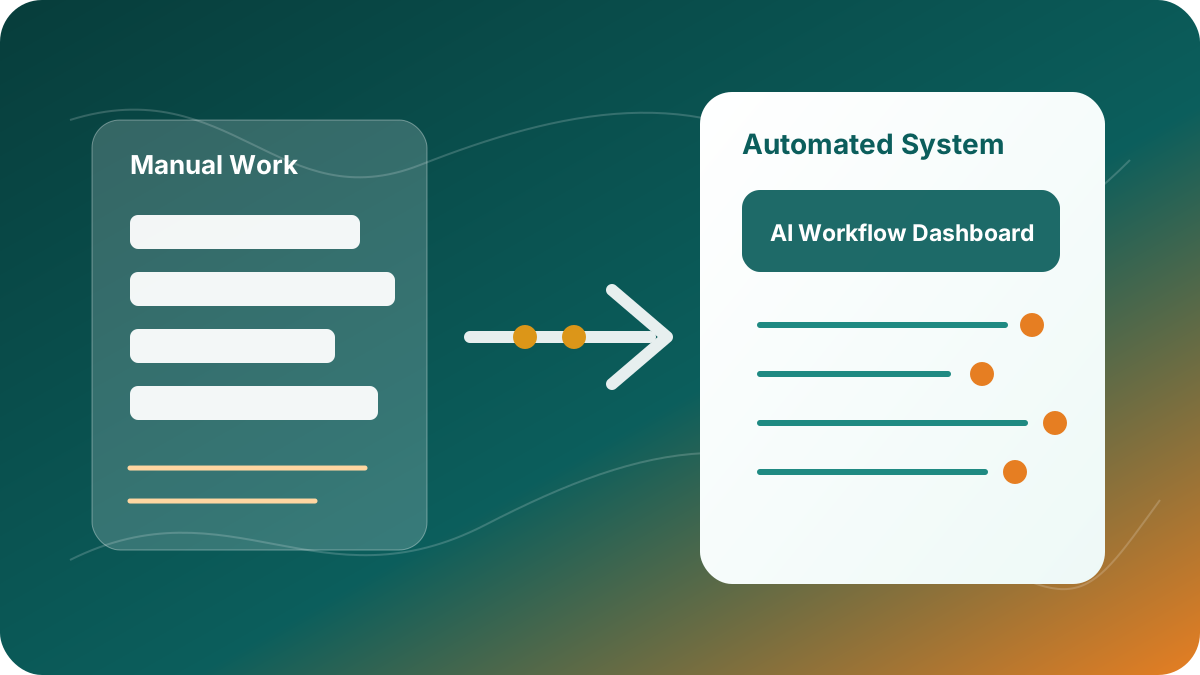
AI-generated editorial visual for real estate operations moving from manual to automated workflows.
Remember the days when every car came with a stick shift? When driving wasn't just about reaching your destination—it was about mastering a skill. You had to press the clutch with precision, time your gear shifts perfectly, and coordinate hand-foot-eye movement with almost surgical accuracy. One wrong move and the whole car would jump, stall, and embarrass you at the traffic light.
We've come a long way since then.
Today, most drivers never think about gear shifts. They slide behind the wheel, press the accelerator, and focus on the road ahead. The transmission handles the complexity invisibly. And now, self-driving cars are emerging on our highways, removing even the steering wheel from the equation.
This isn't just automotive progress. It's a prophecy about your business.
The Three Stages of Every Industry
There's a pattern that repeats across every sector. First, tasks are done manually—they require skill, attention, and sweat. Then, processes become automated, handled by systems and software. Finally, entire workflows operate autonomously, with minimal human intervention.
The companies that thrive through each transition are the ones that embrace it. The ones that resist? They don't just fall behind. Many of them disappear entirely.
In real estate, we're witnessing this evolution right now.
For decades, the industry relied almost entirely on manual processes: agents hand-writing contracts, manually scheduling showings, personally calling every lead, managing paperwork by hand, coordinating with lenders through email chains that span weeks. It was inefficient. It was expensive. And it created an entry barrier that kept many capable people out of the business.
But like the clutch on a 1980s Volkswagen, those manual processes are becoming obsolete.
What Automation Means in Real Estate
If you're running a real estate business today without automation, you're essentially asking your team to drive stick shift in a world of automatics. You're requiring them to manually perform tasks that software could handle in seconds. You're burning through their time—and your profit margins—on repetitive work that adds no real value.
Here's what we're talking about:
Lead Management: Instead of agents manually entering contact information from various sources into your CRM, automation gathers leads from your website, social media, and advertising platforms, logs them automatically, and nurtures them through email sequences without a single human keystroke.
Appointment Scheduling: Clients no longer call to book showings. They click a link, see available times, and confirm instantly. The system sends reminders, sends directions, and updates all parties automatically.
Document Generation: Contracts, disclosures, and agreements are generated from templates in seconds, not hours. Fields auto-populate with buyer and property information. Signature requests go out electronically and return signed without a single printed page.
Follow-up and Nurturing: Not every lead closes in 30 days. Some take months or years. Automated drip campaigns keep your properties and brand in front of prospects without requiring daily attention from your team.
Market Analysis: Instead of spending hours pulling comps and researching neighborhoods, automated valuation tools provide instant pricing insights, market trends, and competitive analysis.
Transaction Coordination: The path from offer to closing involves dozens of steps—inspections, appraisals, title searches, lender communications, insurance coordination. Automation ensures nothing falls through the cracks and keeps everyone informed at every stage.
Want to find the manual work hiding inside your real estate business?
Start with a focused automation review. We look for repeated admin work, disconnected systems, reporting delays, and operational bottlenecks that can be turned into practical software workflows.
Explore the Automation →The Cost of Manual
Let's be direct: manual processes are expensive.
Consider a mid-sized real estate team closing 100 properties per year. If each transaction requires 10 hours of administrative work—data entry, scheduling, document generation, follow-ups, coordination—that's 1,000 hours annually.
At a fully loaded cost (salary, benefits, overhead) of $50 per hour, that's $50,000 per year spent on tasks that don't sell properties.
Now add the hidden costs:
- Errors: A missed step in the transaction process can delay closing by weeks. A misfiled form can cost thousands in legal fees. Manual processes breed mistakes.
- Lost Leads: If your follow-up system depends on someone remembering to call, some prospects will fall through the cracks. Studies show that most real estate leads are lost simply because no one followed up with them.
- Limited Scalability: Your agents are working 50-hour weeks and still can't keep up. You can't grow because you're already at max capacity with manual work. Growth requires hiring more staff, which doubles your administrative burden.
- Staff Burnout: Your best agents didn't choose real estate to spend their days in spreadsheets. When talented people spend more time on admin than on actually helping clients, they burn out and leave.
- Competitive Disadvantage: Your competitor down the street automated their workflow two years ago. They close deals faster, take on more clients, keep agents happier, and run with wider margins.
The Automation Dividend
Companies that implement real estate automation systems report:
- 40-60% reduction in administrative time per transaction
- 25-35% faster transaction closing timelines
- 2-3x improvement in lead follow-up rates
- Higher client satisfaction through faster responses, fewer errors, and transparent communication
- Better team morale because agents focus on client relationships, not paperwork
- Improved profit margins because the same revenue requires significantly less overhead
- Scalability without chaos because adding volume does not linearly increase complexity
More importantly, automation buys something money can't directly buy: time. Time for your agents to develop deeper client relationships. Time for leadership to focus on strategy instead of firefighting. Time to actually grow instead of just surviving.
The Stages of Evolution And Where You Stand
Every real estate business exists at one of three stages:
Stage 1: Manual
You're still relying heavily on personal attention, phone calls, spreadsheets, and paper trails. Your workflow is defined by who shows up and how much they personally hustle.
Stage 2: Partially Automated
You've adopted some tools—a CRM, digital signatures, maybe an automated follow-up system. But your workflow is patchy. Some processes are streamlined, others still require manual input. Your systems don't talk to each other.
Stage 3: Systematized
Your workflow is a seamless ecosystem. Leads flow in automatically, get nurtured systematically, get serviced efficiently, and exit as closed transactions with minimal hands-on intervention. Your team focuses entirely on what only humans can do: building relationships, solving problems, and closing deals.
Most successful real estate businesses are now operating at Stage 3. Many are moving toward Stage 4, where systems are so optimized they begin to achieve autonomous operation in certain areas.
Where are you?
The Uncomfortable Truth
Here's what no one wants to say out loud: If you're still at Stage 1 in 2026, you're in the final years of being competitive.
This isn't hyperbole. In real estate, just like in cars, the technology has already been invented. Automation tools exist. They're not experimental. They're not expensive relative to their return. Thousands of real estate teams are already using them.
The question isn't "Should we automate?" It's "How much longer can we survive without it?"
Your most ambitious agents are already thinking about this. The ones who understand that automation doesn't replace them—it elevates them. It frees them from the clutch pedal so they can focus on what they actually love about the business: helping clients, solving complex problems, and building long-term relationships.
Making the Leap
Automation doesn't happen overnight. And it requires investment—in software, training, and changing how you think about your business.
But the alternative is worse.
Start by identifying your most time-consuming, repetitive processes. For most real estate teams, it's lead management and transaction coordination. Implement a system that automates these. Train your team. Give them a quarter to adjust. Measure the impact.
Then automate the next process. And the next.
Within 18 months, your operation will be unrecognizable. Your overhead will be lower. Your closing times will be faster. Your team will be happier. Your profit margins will be wider. And most importantly, you'll be positioned to grow without the chaos that comes from scaling a manual operation.
The View from the Other Side
Think about what it was like for drivers who finally let go of the stick shift. At first, it felt like something was missing. Like they weren't really driving anymore. But once they adjusted? Once they realized they could focus on the road instead of the transmission?
They never looked back.
The same is true for real estate teams that embrace automation. At first, letting go of manual control feels risky. But once you see leads being nurtured while you sleep, transactions flowing smoothly without daily micromanagement, and your best people focused on what they do best instead of what a computer does better?
You won't miss the clutch pedal.
The Bottom Line
The future of real estate isn't manual, and it isn't even partially automated. It's fully systematized, with teams working with technology, not against it.
You have a choice: automate intentionally now, on your terms and timeline, or have automation forced upon you later when a competitor with better systems steals your market share.
Your car doesn't have a clutch anymore. Your business shouldn't need one either.
The question isn't whether to automate. It's whether you'll do it on your terms, or theirs.