
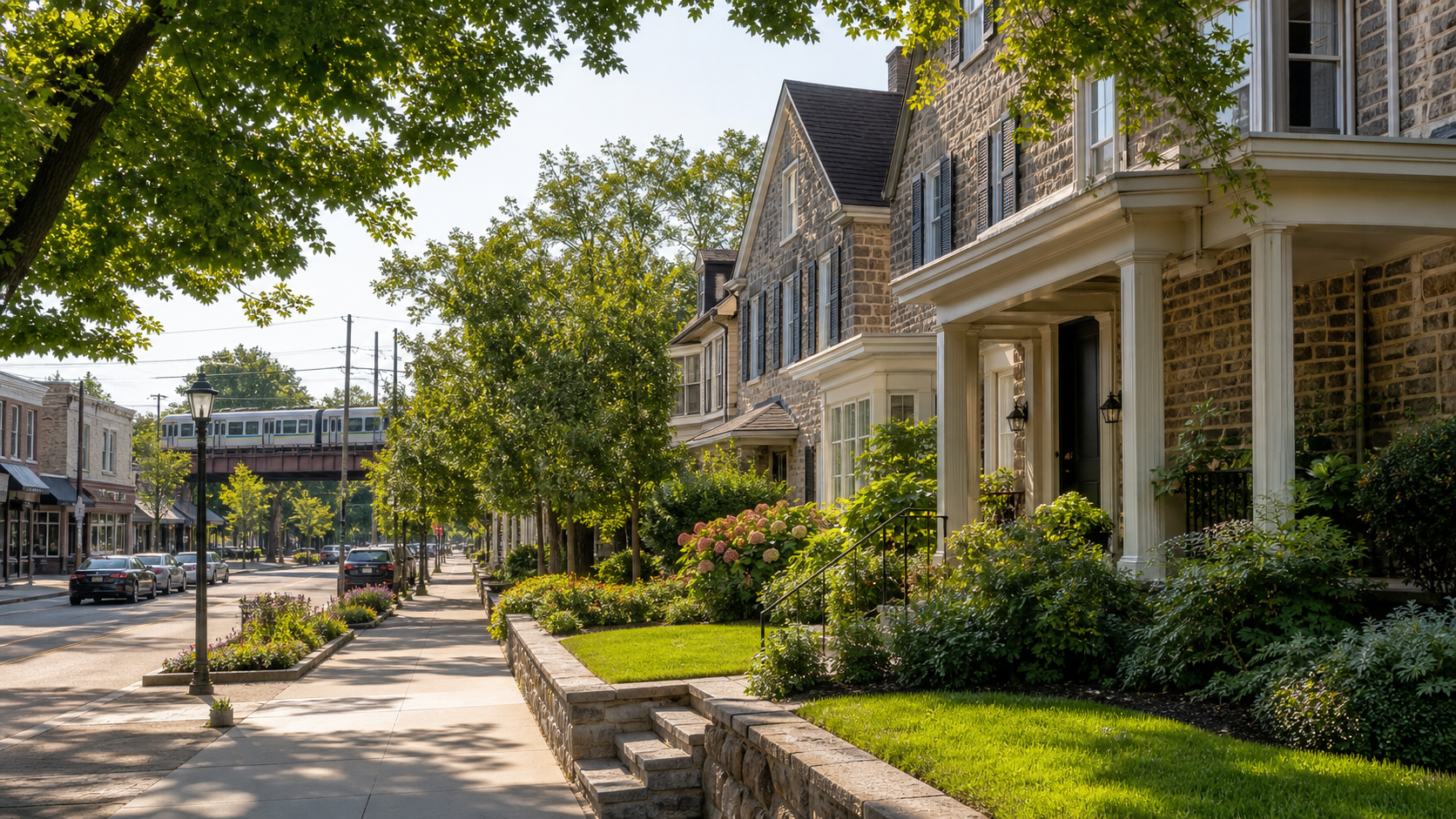
AI-generated editorial visual created for HousingPA to represent Jenkintown's blend of residential, retail, and transit-oriented real estate.
Nestled in Montgomery County just outside Philadelphia, Jenkintown and its neighboring communities, including Abington, Glenside, Wyncote, and Elkins Park, offer a real estate market with a useful mix of stability and variety. The area keeps a historic, walkable borough feel while still offering meaningful opportunities for residential buyers, condo owners, small business operators, and commercial investors.
For many buyers, the appeal is simple: older homes with character, access to the Jenkintown-Wyncote SEPTA station, strong local services, and a sense of neighborhood identity that is hard to manufacture. For investors and operators, the same ingredients create demand for rentals, small offices, mixed-use buildings, and neighborhood retail.
Residential Real Estate: Historic Homes, Condos, and Convenience
The residential market in the Jenkintown area is broad. Depending on the block and municipality, buyers may find historic stone Colonials, Victorians, Tudor-style homes, Foursquare properties, mid-century houses, townhomes, apartments, and condominium buildings.
Market data varies by source because some sources measure the borough, some measure the broader ZIP code, and some blend neighboring communities. Zillow's Jenkintown home value page showed an average home value around $524,090, up about 2.8% year over year as of June 30, 2026. Realtor.com showed a lower active-listing snapshot for Jenkintown and the 19046 ZIP code, reflecting how much the reported number can change based on the data set and active inventory.
Single-Family Homes
Single-family neighborhoods around Jenkintown are often defined by mature trees, sidewalks, traditional architecture, and access to shops, schools, parks, and transit. Many homes were built before the modern subdivision era, so buyers often weigh charm and location against renovation needs, older systems, and lot-by-lot condition differences.
For commuters, the SEPTA connection remains one of the area's strongest real estate advantages. A home within convenient reach of the Jenkintown-Wyncote station can serve buyers who want a suburban setting without fully giving up access to Center City Philadelphia.
Schools and Local Demand
Schools are a major driver of residential interest. The Jenkintown School District has received strong public rankings, including a high Montgomery County and statewide placement in Niche's 2025 rankings as reported by Montco.Today. Abington and Cheltenham schools also shape demand in the surrounding communities, depending on the exact property location.
Condos, HOAs, and Low-Maintenance Living
Jenkintown's condo and HOA market is important because it gives buyers an alternative to maintaining an older single-family home. Buildings such as Beaver Hill and other nearby condo or apartment communities appeal to downsizers, commuters, investors, and residents who value lower-maintenance ownership.
In this market, buyers should look beyond the unit price. HOA fees, capital reserves, parking, rental rules, pet policies, building systems, assessments, and insurance structure can meaningfully affect the long-term cost of ownership.
- Predictable maintenance: Exterior care, landscaping, common areas, and snow removal may be handled by the association.
- Amenities: Some buildings offer pools, fitness areas, front-desk service, shared laundry, storage, parking, or secure entry.
- Fee structure: Some monthly fees may include utilities or services, while others leave more costs to the individual owner.
- Rules and resale: Rental caps, pet limits, financing eligibility, and capital assessments should be reviewed before purchase.
Buying, selling, or evaluating property around Jenkintown?
HousingPA helps real estate owners and operators think through value, operations, automation, maintenance workflows, and practical next steps.
Start a Conversation →Commercial Real Estate: Walkability and Visibility
Jenkintown is not only a residential community. It also functions as a small commercial hub with walkable streets, neighborhood-serving retail, professional offices, and access to major corridors such as Old York Road. That combination can be attractive for businesses that want visibility without the scale or cost profile of a larger urban core.
The most interesting commercial opportunities often sit at the intersection of local traffic, pedestrian activity, and adaptive reuse. Older buildings may offer storefronts, second-floor offices, or mixed-use income potential, but investors should evaluate zoning, parking, accessibility, tenant demand, and property condition carefully.
Retail and Mixed-Use Properties
Downtown Jenkintown and nearby corridors support cafes, service businesses, professional users, boutique retail, restaurants, wellness concepts, and small offices. Mixed-use buildings can provide diversified income when the commercial space and upper-floor residential or office space are both supported by the location.
Office and Professional Services
Medical, legal, financial, therapy, wellness, and real estate service users remain natural fits for the broader area. Proximity to hospitals, established residential density, and commuter routes can support demand for professional office space, especially when parking and accessibility are handled well.
Neighboring Communities: Glenside, Wyncote, and Elkins Park
The Jenkintown-area story does not stop at the borough line. Nearby communities each add a different flavor to the local market.
- Glenside: Known for established residential streets, historic architecture, the Keswick Theatre area, and a practical mix of homes and local services.
- Wyncote: Known for historic homes, larger properties in some pockets, and a more residential feel with access to nearby retail and transit.
- Elkins Park: Known for architectural variety, older estates, apartments, religious and educational institutions, and a diverse housing stock.
- Abington: A larger surrounding market with strong residential demand, shopping corridors, healthcare anchors, and multiple neighborhood identities.
The Takeaway
Jenkintown works because it has more than one real estate story. It is a historic residential market, a commuter-friendly location, a condo and HOA market, and a small commercial corridor all at once. That mix gives buyers and investors options, but it also makes property-by-property analysis important.
For a homeowner, the question may be school district, walkability, and maintenance. For a condo buyer, it may be HOA strength and building condition. For a commercial investor, it may be tenant demand, zoning, parking, and visibility. The same local charm that draws residents can also support neighborhood businesses when the property and use are aligned.